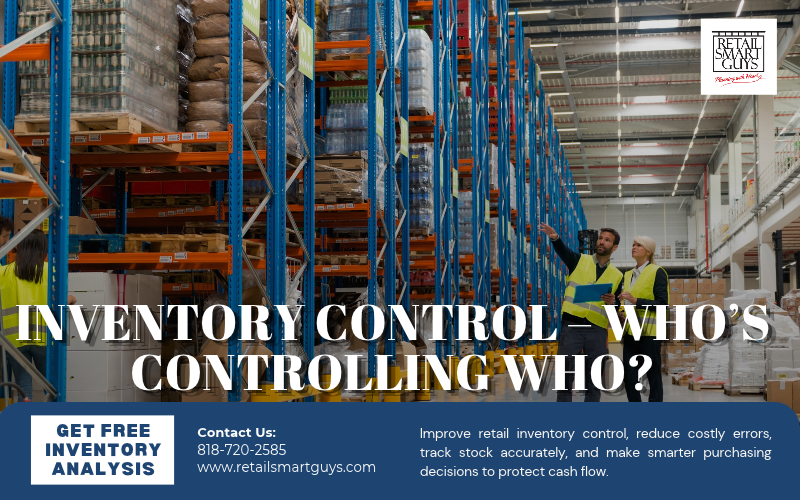
Your inventory is one of your biggest investments. Is it working for you—or working against you?
Retail is rewarding. You get to help customers, make sales, discover new products, and build relationships in your community. But there’s another side of retail that isn’t nearly as exciting: inventory control.
It takes time, attention, and consistent processes to keep inventory accurate. Even retailers with established systems can struggle with missing items, incorrect quantities, duplicate product records, and reports that don’t reflect what’s actually on the sales floor.
Why does it matter so much?
Because inventory accuracy affects sales, cash flow, profitability, and customer confidence.
Let’s look at where inventory control can go wrong—and what you can do to improve it.
1. Why Inventory Accuracy Matters
Inventory is more than merchandise sitting on shelves. It’s money your business has invested in products you expect to sell.
When your inventory records are inaccurate, you can make decisions based on information that isn’t true.
If your system shows more merchandise than you actually have, you may promise customers products that aren’t available. If your system shows less than you have, you may miss sales opportunities or place unnecessary replenishment orders.
These problems can also distort sales reports, purchasing decisions, and merchandise planning.
Accurate inventory helps you answer three essential questions:
- What merchandise do I have?
- Where is it located, and how long has it been there?
- What is my plan to sell it?
Without reliable answers, it’s difficult to make informed buying decisions or manage your cash effectively.
2. Start With Your POS Setup
One source of inventory errors is an inconsistent or poorly structured point-of-sale (POS) system.
Begin by reviewing your department, class, and subclass structure. Each product should have a clear, consistent place in your merchandise hierarchy.
If an item could reasonably be entered into multiple categories, your structure may need clarification.
Next, review your product fields. Make sure each field has a defined purpose, and train staff to use it consistently.
For example, product color shouldn’t appear as “BLK,” “BLACK,” “BLC,” and “BLCK” across different records if your reporting depends on consistent color names.
Standardized data makes products easier to find, reduces duplicate entries, and improves reporting.
The goal is simple: establish clear rules, document them, and make sure everyone follows them.
3. Get Purchasing and Receiving Right
Inventory accuracy begins before merchandise reaches your sales floor.
When entering purchase orders, check whether an item already exists in your system before creating a new record. Duplicate product entries can split sales and inventory information across multiple records, making the numbers harder to trust.
Gather accurate product information from vendors, including:
- Vendor and style numbers
- Product descriptions and variants
- Correct cost and retail price
- UPC or barcode information, where applicable
Don’t wait until merchandise arrives to resolve information that should have been confirmed during ordering.
When goods arrive, verify that the shipment matches the purchase order and record the receipt accurately.
Vendor returns require the same attention. Make sure returned merchandise is properly documented and removed from inventory records according to your system’s process.
Small mistakes repeated across multiple orders can become significant inventory problems.
4. Train Your Team to Ring Up the Right Item
Checkout is another common source of inventory inaccuracies.
When a barcode won’t scan or a tag is missing, employees may be tempted to ring up a similar item with the same price. That might seem like a quick solution, but it creates incorrect records.
The sale is recorded against the wrong product, and the inventory quantities for both items may become inaccurate.
Other problems can occur when employees enter barcode numbers into the wrong POS fields or use generic “junk” or “jackpot” items to complete transactions.
These shortcuts can distort inventory counts, sales reports, and markdown reporting.
To prevent them:
- Train employees to look up products when a barcode fails.
- Establish a clear procedure for missing or damaged tags.
- Review recurring POS entry mistakes with your system provider.
- Investigate generic-item transactions rather than allowing them to become routine.
- Correct errors promptly using the appropriate POS procedures.
Make sure employees understand that recording the correct item is more important than simply completing a transaction quickly.
5. Record Every Inventory Movement
Inventory doesn’t leave your system only when a customer purchases it.
Products may be transferred between stores, used for demonstrations, removed for charitable donations, or taken out of stock for other business purposes.
Every movement needs the correct documentation.
For businesses with multiple locations, transferred quantities should match the quantities received at the destination. Establish clear procedures for recording, shipping, receiving, and investigating discrepancies.
For other inventory removals, use the appropriate inventory adjustment process rather than recording an artificial zero-dollar sale. Incorrect transaction methods can distort sales and margin reports.
Clear procedures help you maintain accurate records and investigate discrepancies before they become larger problems.
6. Assign Someone to Own Inventory Accuracy
A POS system cannot maintain accurate inventory by itself.
Someone in your organization needs clear responsibility for the system’s setup, data quality, inventory processes, and reporting.
This person should understand how the POS works, recognize unusual transactions, and ensure that employees follow established procedures.
That doesn’t mean one person must perform every task. It means someone is accountable for monitoring the process and making sure problems are addressed.
Without clear ownership, small mistakes can continue unnoticed until they affect purchasing, sales, and financial reporting.
7. Use Reports to Catch Problems Early
Many retailers regularly review sales reports but overlook the reports that can help explain inventory discrepancies.
Build a routine around reviewing:
- Receiving reports: Confirm that incoming merchandise was recorded correctly.
- On-hand reports: Identify negative inventory and unusual quantities.
- Inventory adjustment reports: Investigate unexplained changes.
- Transfer reports: Confirm that merchandise movements were completed properly.
- Generic-item sales reports: Find transactions that may indicate incorrect product entry.
Don’t just run the reports. Investigate the exceptions.
If an item has negative inventory, determine why. If a generic item appears repeatedly, find out why employees are using it. If a transfer doesn’t balance, trace the transaction.
The sooner you identify the cause, the easier it is to correct the process.
8. Count Inventory Throughout the Year
A physical inventory helps you compare your system records with the merchandise actually on hand.
Many retailers perform a full physical count annually, but a once-a-year count may reveal problems long after they began.
Use the results to investigate discrepancies instead of simply adjusting the system and moving on.
Dan Jablons’s original guidance recommends investigating differences greater than 1%. Treat that figure as a prompt for review, not a universal benchmark; the appropriate tolerance depends on your business, inventory type, and counting process.
Consider adding cycle counts—smaller physical counts focused on selected departments, vendors, or product groups throughout the year.
Cycle counting helps you identify recurring errors earlier and reinforce accountability between annual inventories.
What Better Inventory Control Can Do for Your Business
Consistent inventory control can help you:
- Reduce missed sales caused by inaccurate availability.
- Identify slow-moving or unproductive merchandise.
- Free up cash by making better decisions about inventory.
- Investigate shrinkage and unexplained losses.
- Evaluate merchandise and vendor performance more reliably.
- Improve purchasing decisions and Open-to-Buy planning.
Inventory control takes work, but inaccurate inventory can cost you even more in lost opportunities, unnecessary purchases, and poor decisions.
Take Control With Retail Smart Guys
Your inventory should support your business goals—not leave you guessing about what you own, what you need, or where your cash is tied up.
At Retail Smart Guys, we help independent retailers connect inventory management with merchandise planning, Open-to-Buy, purchase order entry, reporting, bookkeeping, and cash flow planning.
We combine practical retail experience with data and AI-supported insights to help retailers make informed decisions and build stronger processes.
Actual Intelligence + Artificial Intelligence = Retail Smart Guys.
Because technology can help organize the information, but real retail experience helps you understand what to do with it.
Take control of your inventory, strengthen your processes, and give your business a better foundation for growth.
That’s Planning With Heart.
Better Plans, Better People, Better Pricing
Get a FREE INVENTORY ANALYSIS.
Best,
Dan Jablons
Retail Smart Guys
Cell: 818-720-2585