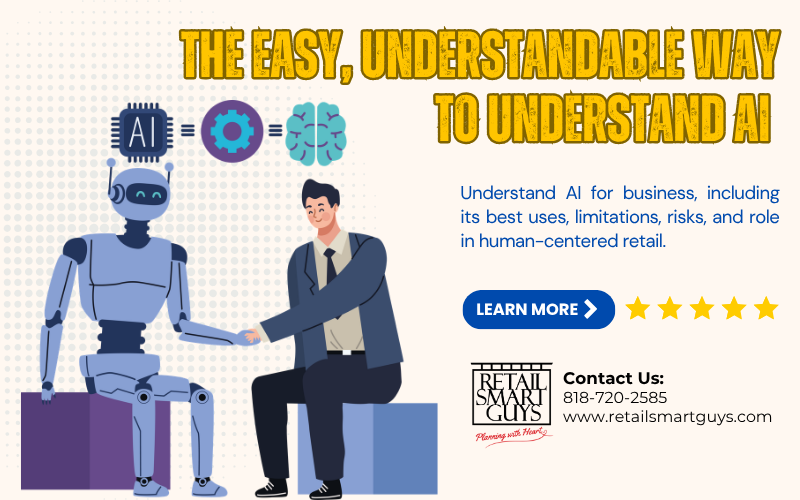
Everywhere you look, someone is talking about Artificial Intelligence (AI). It’s everywhere, almost inescapable, partly because it promises to help us collect more information than we’ve ever had, and partly because everyone thinks there’s money to be made by providing it to you.
Sure, it’s the next wave of great technology, but as with all new waves of technology and all business fads, the great promise of AI includes its share of half-truths, exaggerated promises, and false assumptions.
So, let’s break it down. Let’s keep it simple. Let’s talk about what we can and can’t expect. Oh, and before we go any further, let me confirm to you that this was written by a real human being, not an AI bot!
FIRST, LET’S DEFINE IT
I searched for a while to find a great definition. I even asked a couple AI engines like Claude, Gemini, and others. Guess what, all of them said, “there is no single universally agreed upon definition” and then did their best to define it. (This hints at the real issue of AI, that I’ll discuss below).
That said, the best definition I could cobble together is that AI is “a computer system that performs tasks which, up until now, required human intelligence, such as understanding language, recognizing patterns, and anticipating word choices.”
To me, that just means that AI is like having someone you can ask questions to, and they’ll seek out the answers. It’s easier than having to learn how your software program works. For example, in the past if you wanted to know what your top selling products were, you had to learn how to run a report, sort it, filter it, etc. Now, you can just say, “what are my top selling products” and AI will figure it out.
Sorta. Why do I say that? Because “top selling items” could be defined a lot of ways. Top selling based upon units or dollars? Should we include tax? Do we consider it a top seller before or after discounts? And is it a top seller because we were over inventoried, so we had to sell it?
You can see where this is going. AI is great technology but requires very specific instructions and dialogue to really answer your questions. This means that you must know what you’re doing when you interface with AI, even though it has the appearance of being your best friend who is listening to what you need and providing it.
MY FAVORITE AI ANOLOGIES ABOUT AI
I’m a long time fan of analogies because they do an excellent job of clarifying complex concepts. Here are my favorites regarding AI.
Analogy #1: AI is like having a room full of ambitious, smart teenagers who really want to help you. You ask them questions, they’ll do their level best to answer them, but a large percentage of it will be wrong.
Analogy #2: AI is like hiring a Doctor of Philosophy from an ivy league school to pick out your socks. It will throw a lot of stuff at you, but in the end you’ll pick the socks you like.
But wait, that makes it sound like AI is not great, yet everyone says it’s the greatest thing ever! AI is great, has great promise but you must learn how to use it. Which leads to my next analogy.
Analogy #3: Using AI without really understanding it is like saying, “I hear people make money in that Stock Market, so I’m just gonna throw money in there and see what happens.” Investing in stocks requires experience, information, and know-how. The same is true for AI.
WHAT ARE THE BEST USES OF AI?
I’ve done a lot of research on this. I’ve talked to lots of programmers, AI providers, and more. After studying tons of use cases, successes and failures, I have some ideas for you about the best ways to use AI for your business.
Let me start by giving you a new phrase I made up (all on my own, without AI!): “Action Sports is a HUMAN business. AI is a machine. Own the machine, but do not lose your humanity!”
In short, the best use of AI today is to ask it questions, let it give you answers, but take those as advice, not as the final answer, and apply what you know about your business and your customers to that advice. You must control AI, and not allow AI to run you or your business. That’s the key to success.
We are already seeing tremendous blowback when businesses let AI send out automated messages. Humans can tell an AI generated message a mile away, and they do not like it. In fact, this has created an interesting trend where humans, especially younger shoppers, are hungering for real, genuine human experiences, and want nothing to do with AI.
So let’s consider AI to be our best advisor, a ghost writer, and a great brainstorm partner.
AI does a great job of creating FIRST DRAFTS in these areas:
- Writing job descriptions
- Writing promotional messages
- Coming up with in store event ideas
- Researching complex questions on the internet.
- Creating outlines and training manuals for new employees
- Replenishment of basic stock programs (but be careful, it will only replenish, it won’t optimize the inventory)
Why do I say “first draft”? Because the language that AI uses is not your language. Your customers want to hear what you have to say, not what a machine has to say. Take the outputs from above and edit them, transform them into how you yourself express these ideas, and that is a great way to use AI.
AI AREAS TO AVOID
As of this writing, there are some areas of AI that we see perform badly. That will change in time, I’m sure, as more developers work on better solutions. We all need to watch these developments to see how this will improve, but at this moment we must be careful.
Do this test for yourself. Pick any job in your business that you want AI to write a job description for. Write your best, most detailed prompt, and it will give you a pretty good write up. Now, do that again a few days later, with the exact same question, and you’re going to get a different response! Why? Because AI is a “black box” and it evolves and changes with what it sees on the internet and has no memory of what it already told you.
This is, in part, why generic AI becomes unreliable. It changes its mind on a daily basis. This is why it can be very dangerous with numeric calculations, which we have seen to produce inconsistent and incorrect results.
For now, I’d be very cautious about the following:
- Financial Planning and Forecasting – AI does its best to make it work, but does not understand all the variables, intricacies and oddities of our business. It does not understand seasonality, markdowns, or the vital need for fresh merchandise to excite the consumer. In all our tests, AI simply attempted to “straight line” all the key factors (to simplify it for us humans) and it got it wrong.
- Inventory Optimization – AI does a decent job of helping in replenishment stocks. But it does not create the optimum inventory levels necessary to create healthy cash flow and growth. It understands the math of replenishment but does not know how to grow a business. It might see trends, and it will tell you about trends, but it will not effectively tell you how to capitalize on those trends.
- Data Entry – some of this works, but a lot of it doesn’t. For example, lots of companies now are promising that vendor purchase orders can be read by AI and added to POS systems. That’s only 25% true – it can add whatever it sees on the PO, but does not properly classify it, does not give it usable, human language descriptions, does not tag it properly, and since the retail is often not on the PO, it doesn’t know how to price it. So importing PO’s this way is actually MORE time consuming than just entering them yourself.
MY BEST AND FINAL ADVICE (for now)
AI is certainly helping to remove a lot of time consuming work from a lot of people, and used above, it can be very helpful. Just remember, it is a tool, not the boss (you still are), and you need to learn how to use that tool effectively.
One of the things we’ve seen that is most important is to give AI a solid, reliable set of data to review, not just let it run out across the whole internet, to give you the best responses. That’s how we’re using it for forecasting, and it gives us excellent first drafts (which real humans work with to come up with the final, proper forecasts).
Here are things I’d keep an eye on:
- Prompts – lots of people are already talking about the importance of “prompts” which are the things you ask AI so you get the best results. Learning that language is the key to getting meaningful data from AI.
- Customer reactions – as I noted above, customers do not like pure AI responses. Watch how this develops, and make sure your customers see the real you, the real personality and culture of your business.
- Work with AI professionals who understand what these tools are doing and know how to manipulate them properly. Just running to an AI site and asking business questions is a path to bankruptcy. I’ve seen it happen to 3 businesses I know.
- Keep up with the news about AI. Things are changing all the time. But don’t just look for the promises – look for actual business cases of actual real solutions.
I believe in AI. I believe it will make our lives better. It already is in some areas. But do NOT let it remove the humanity of our industry. All of us need to keep our heart in the game.
Get a FREE first hour of setup.
Best,
Dan Jablons
Retail Smart Guys
Cell: 818-720-2585